Dynamic modeling, control, and planning for marine vehicles
Advancing marine autonomous vehicle capability
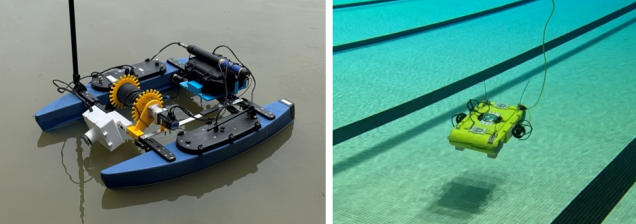
(Left) Autonomous surface vehicle. (Right) Autonomous underwater vehicle.We are focused on advancing modeling, analysis, control, and planning for autonomous robotic systems operating in complex and uncertain marine environments. We focus on lightweight underwater vehicle-manipulator systems (UVMSs), autonomous underwater vehicles (AUVs), and autonomous surface vessels (ASVs), addressing fundamental challenges associated with complex dynamics, environmental uncertainty, and operational constraints that affect system performance, reliability, and long-term autonomy.
Our research develops physics-based and data-driven stochastic models to characterize marine robotic dynamics, quantify uncertainty, and enable long-term, near-real-time predictions through computationally efficient and parallelized approaches. Building on these models, we develop model-based, optimal, robust, and learning-based control strategies to enhance the reliability, efficiency, and autonomy of marine robots. Our planning research focuses on coverage path planning, optimal risk-aware receding-horizon planning under model uncertainty, and dynamic obstacle avoidance for reliable marine autonomous navigation.
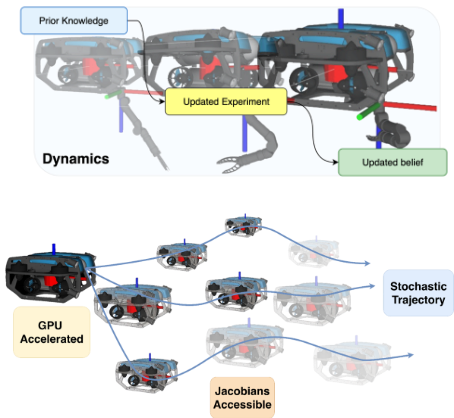
(Top) Our research advances the understanding of underwater vehicle dynamics and performance by fusing prior knowledge and models of the robots with in-situ observations about the robot and environmental factors. (Bottom) GPU-accelerated computation enables stochastic trajectory planning, optimization, and advanced control.
These projects have been funded by the National Science Foundation, Office of Naval Research, and Defense Advanced Research Projects Agency.